Imagine a child who loves drawing. She spends hours filling page after page with colours, simply because it is fun. One day, a parent decides to be supportive and starts paying her for every drawing. At first, it feels exciting. But slowly, something changes: she draws to get paid, not because she loves it.
Then, when the payment suddenly stops, she stops drawing too.
This is not just a sad story. It is a well‑documented psychological phenomenon called the overjustification effect, and it affects how we work, learn, parent and even design incentive systems in business (Study.com, 2016; Wikipedia, 2024).
What is the overjustification effect?

The overjustification effect occurs when an expected external reward, such as money, bonuses, grades or prizes, reduces a person’s intrinsic motivation to perform an activity they previously enjoyed for its own sake (Study.com, 2016; The Decision Lab, 2021; Wikipedia, 2024).
In simple terms:
When you start rewarding someone for something they already like doing, you risk making them do it only for the reward – and destroying the original joy in the process (Study.com, 2016; The Decision Lab, 2021).
Once the reward stops, interest often drops below the original level. The person no longer sees the activity as “what I love”, but as “what I do for payment or approval” (Study.com, 2016; The Decision Lab, 2021).
Deci’s classic SOMA puzzle experiment (1971)
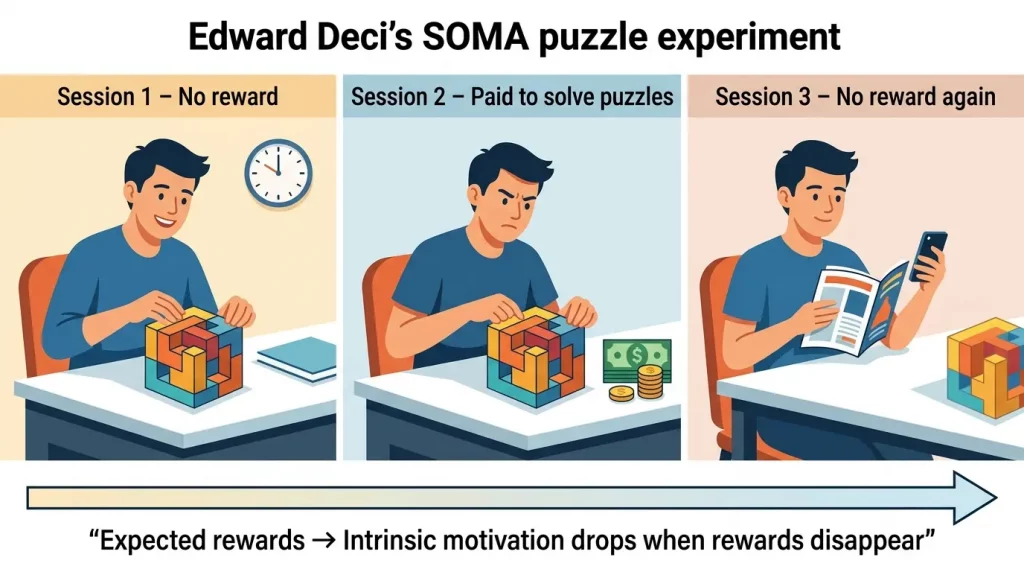
Psychologist Edward Deci was one of the first to test this effect in a controlled experiment (Deci, 1971; Deci, 1972; Ryan et al., 2019). In 1971, he asked university students to work on enjoyable three‑dimensional SOMA puzzles over several sessions (Deci, 1971; Ryan et al., 2019).
In the first session, both groups simply played with the puzzles and reported that they genuinely liked the task (Deci, 1971; Progress Focus, 2020). In the second session, one group continued as before, while the other group was told they would be paid for each puzzle they completed (Deci, 1971; Progress Focus, 2020). In the third session, the researcher left the room and told students they could do whatever they wanted – keep solving puzzles, read magazines, or just sit (Deci, 1971; Progress Focus, 2020).
The crucial measure was how long students chose to keep solving puzzles when nobody was watching. Deci found that students who had never been paid kept working on the puzzles as much as before, while students who had been paid spent significantly less time on them once the money disappeared (Deci, 1971; Deci, 1972; Progress Focus, 2020).
In other words, the reward had undermined their intrinsic motivation. What used to be “I do this because it is interesting” turned into “I do this because I get paid for it” – and when the payment stopped, their motivation collapsed (Deci, 1971; Ryan et al., 2019).
A clear summary of this research and its role in Self‑Determination Theory can be found in Ryan, Ryan and Di Domenico’s overview of Deci’s work (Ryan et al., 2019). The original line of experiments is discussed in detail in Deci’s early papers on intrinsic motivation and extrinsic reinforcement (Deci, 1971; Deci, 1972).
Intrinsic vs extrinsic motivation
To understand why this effect is so powerful, it helps to distinguish two broad types of motivation (Ryan & Deci, 2000; Verywell Mind, 2013).
- Intrinsic motivation: doing something because it is interesting, enjoyable or meaningful to you – for example, learning a skill, playing music or solving a puzzle (Ryan & Deci, 2000; Ryan et al., 2019).
- Extrinsic motivation: doing something because of an external outcome – such as money, grades, praise, social status, or avoiding punishment (Ryan & Deci, 2000; Ryan et al., 2019).
Self‑Determination Theory, developed by Edward Deci and Richard Ryan, suggests that intrinsic motivation thrives when three basic psychological needs are met: autonomy, competence and relatedness (Ryan & Deci, 2000; Wikipedia, 2024).
- Autonomy – feeling that you are choosing your actions.
- Competence – feeling that you are getting better at something that matters.
- Relatedness – feeling connected to others through what you do.
Poorly designed rewards can accidentally undermine autonomy (“I am only doing this because of the KPI”), distort competence (“I am only good if I hit this bonus threshold”), and weaken genuine connection (“I post this only for likes, not for sharing something meaningful”) (Ryan & Deci, 2000; Ryan et al., 2019).
Everyday examples: where rewards crowd out passion
The overjustification effect is not limited to psychology labs. It appears in everyday life, often in places where we think we are helping motivation (Study.com, 2016; The Decision Lab, 2021).
- At school: parents pay children for good grades. Over time, the child may only study for money, not for curiosity. Subjects without rewards feel pointless (Study.com, 2016).
- At work: companies set aggressive KPI‑based bonuses. Employees focus narrowly on what is measured and rewarded, lose the joy of mastering their craft, and become less willing to experiment or take smart risks (Ryan & Deci, 2000; TheoryHub, 2026).
- On social media: creators who once posted out of genuine interest may eventually create content only for likes, views and followers. When engagement drops, their motivation crashes, even if they still love the topic (The Decision Lab, 2021).
- In our personal systems: we promise ourselves, “If I go to the gym for 30 days in a row, I will buy new trainers.” At first it helps us start, but soon the focus shifts from health and strength to the purchase. Once the purchase is done, or feels too far away, the behaviour often stops (Study.com, 2016).
Three ways to rebuild intrinsic motivation
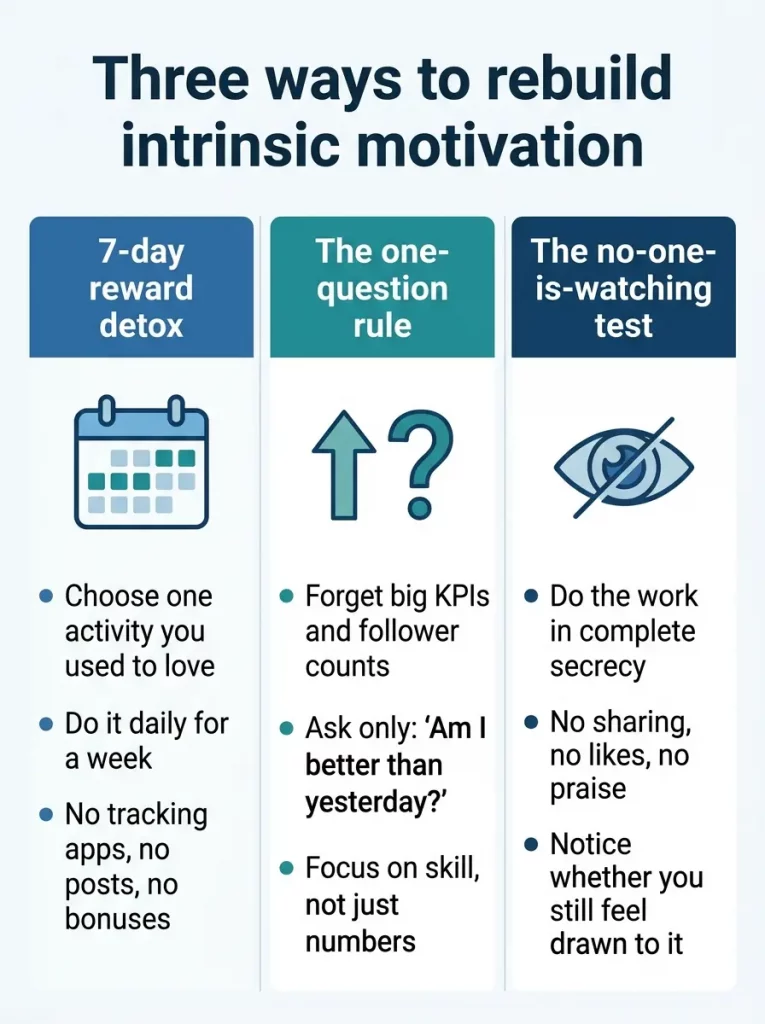
If rewards can damage our inner drive, how do we get it back? Building on Self‑Determination Theory and the ideas explained in the video, we can highlight three practical – but not easy – methods to rediscover intrinsic motivation (Ryan & Deci, 2000; Ryan et al., 2019).
1. The 7‑day “reward detox”
First, choose one activity that you suspect you used to love – for example writing, drawing, coding, playing an instrument or exercising.
For seven days:
- Do the activity every day.
- No tracking apps, no public posting, no counting likes or followers.
- No self‑bribery such as “If I do this, I can buy X.”
- No KPI or performance goals.
The first few days may feel strangely empty or even pointless – this is the withdrawal from external rewards. If you stay with it, many people start to feel small sparks of enjoyment again: the feeling of focus, small discoveries, the satisfaction of making something a little better.
2. The “one question” rule
Instead of obsessing over numerical targets such as “100 drawings”, “10,000 followers” or “£X per month”, try replacing your goals with a single daily question (Ryan & Deci, 2000; Ryan et al., 2019):
“Am I better at this than I was yesterday?”
This shifts your attention from external outcomes to mastery and competence – one of the core needs that fuel intrinsic motivation (Ryan & Deci, 2000; TheoryHub, 2026). You still care about progress, but you define progress by skill, not only by metrics.
3. The “no one is watching” test
Finally, ask yourself:
“If no one else ever knew that I did this – no money, no praise, no likes, no status – would I still want to do it?”.
Run a small experiment:
- Do your chosen activity in complete secrecy for a while.
- Do not post about it, show it to anyone, or use it for networking or branding.
If you still feel drawn to it, even when it does not “perform” for you in public, that is a strong sign of intrinsic motivation. If the activity only feels meaningful when others see it, that may be a sign that you are mostly running on external rewards (Ryan & Deci, 2000; TheoryHub, 2026).
Implications for work, marketing and education
For marketers, managers and educators, the overjustification effect is more than an interesting theory – it is a design problem (Ryan & Deci, 2000; TheoryHub, 2026).
- How do you design incentive systems that support autonomy and mastery instead of replacing them?
- How do you create marketing careers where people stay curious about users and experiments, not just dashboards and bonuses?
- How do you build content strategies that balance performance metrics with genuine interest in the subject?
Self‑Determination Theory suggests that rewards which are informational, giving useful feedback and recognising real progress, are less harmful than rewards which are controlling – “hit this number or you are a failure” (Ryan & Deci, 2000; Ryan et al., 2019).
When you support people’s sense of autonomy, competence and relatedness, intrinsic motivation – and deep, sustainable performance – are much more likely to grow (Ryan & Deci, 2000; TheoryHub, 2026).
A question to leave you with
To finish, consider this question:
“What are the few things in your life that you would still do if there were no bonuses, no grades, no likes and no titles?”
Helping people reconnect with those activities – and protecting them from being suffocated by badly designed rewards – might be one of the most valuable performance strategies we have (Ryan & Deci, 2000; Ryan et al., 2019).
References
- Deci, E.L. (1971) ‘Effects of externally mediated rewards on intrinsic motivation’, Journal of Personality and Social Psychology, 18(1), pp. 105–115.
- Deci, E.L. (1972) ‘Intrinsic motivation, extrinsic reinforcement, and inequity’, Journal of Personality and Social Psychology, 22(1), pp. 113–120. Available at: https://selfdeterminationtheory.org/SDT/documents/1972_Deci_JPSP.pdf (Accessed: 15 April 2026).
- Progress Focus (2020) ‘Classic research Edward Deci (1971): the undermining effect of rewards on intrinsic motivation’. Available at: https://www.progressfocused.com/2020/09/classical-research-edward-deci-1971.html (Accessed: 15 April 2026).
- Ryan, R.M., Ryan, W.S. and Di Domenico, S.I. (2019) ‘Beyond reinforcement: Deci (1971) on the effects of rewards on intrinsic motivation’, in Deci, E.L. and Ryan, R.M. (eds.) Self-Determination Theory: Basic Psychological Needs in Motivation, Development, and Wellness. Available at: https://selfdeterminationtheory.org/wp-content/uploads/2019/03/2019_RyanRyanDiDomencio_Deci1971.pdf (Accessed: 15 April 2026).
- Ryan, R.M. and Deci, E.L. (2000) ‘Self-determination theory and the facilitation of intrinsic motivation, social development, and well-being’, American Psychologist, 55(1), pp. 68–78.
- Study.com (2016) ‘Overjustification effect: definition & examples’. Available at: https://study.com/learn/lesson/overjustification-effect-motivation-examples.html (Accessed: 15 April 2026).
- The Decision Lab (2021) ‘Overjustification effect’. Available at: https://thedecisionlab.com/biases/overjustification-effect (Accessed: 15 April 2026).
- TheoryHub (2026) ‘Self-Determination Theory: a review’. Available at: https://open.ncl.ac.uk/theories/20/self-determination-theory/ (Accessed: 15 April 2026).
- Verywell Mind (2013) ‘How Self-Determination Theory explains motivation’. Available at: https://www.verywellmind.com/what-is-self-determination-theory-2795387 (Accessed: 15 April 2026).
- Wikipedia (2024) ‘Overjustification effect’. Available at: https://en.wikipedia.org/wiki/Overjustification_effect (Accessed: 15 April 2026).
- Wikipedia (2024) ‘Self-determination theory’. Available at: https://en.wikipedia.org/wiki/Self-determination_theory (Accessed: 15 April 2026).