


The March 2026 spam update is Google’s latest move to reduce low‑quality and manipulative content in search results. In this article, you will find a clear summary of the update and a deeper look at the advanced spam techniques Google is continually working to shut down.
What Is The March 2026 Spam Update?
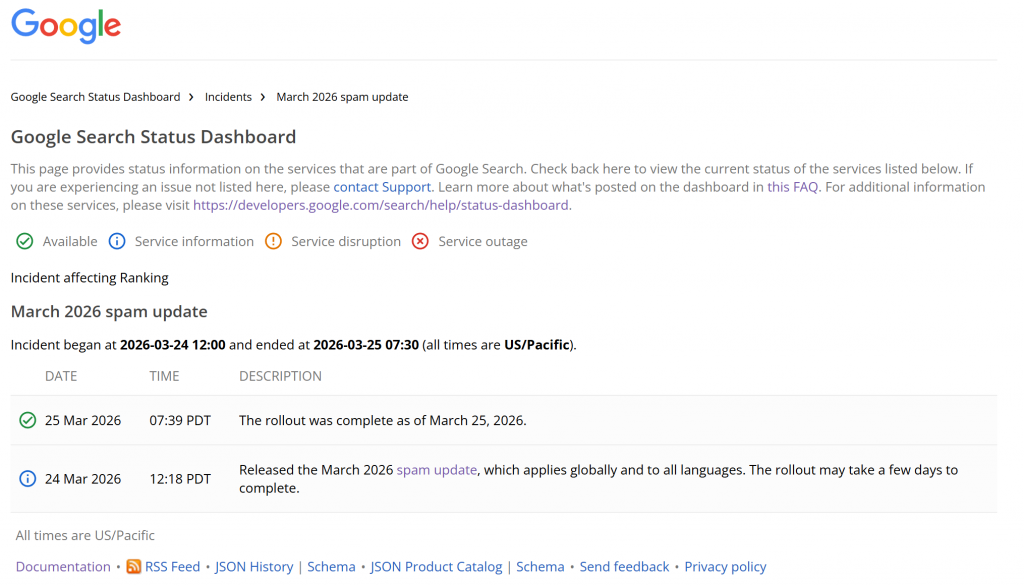
According to the Google Search Status Dashboard, the March 2026 spam update began rolling out on 24 March at 12:00 PM PT and finished on 25 March at 7:30 AM PT, with the completion note published at 7:39 AM PDT.
The rollout lasted less than 20 hours, making it one of the fastest confirmed spam updates to date. The update applies globally and to all languages and is listed as an incident affecting ranking.
Google’s official description states: “Released the March 2026 spam update, which applies globally and to all languages. The rollout may take a few days to complete.”
Importantly, Google did not publish a companion blog post or introduce new spam policy categories with this update. Based on what is public, this is a standard spam update that tightens enforcement of existing spam policies rather than expanding them, unlike the March 2024 update that introduced scaled content abuse, expired domain abuse and site reputation abuse as new spam categories.
How Spam Updates Work (In Plain Terms)
Spam updates are improvements to Google’s spam‑prevention systems, such as SpamBrain. They focus on sites that violate spam policies, which can lead to significantly lower rankings or complete removal from search results.
These updates are different from core updates. Core updates re‑assess overall content quality and relevance, while spam updates enforce rules against clear violations like cloaking, link spam and content abuse.
If a site is hit by a spam update, recovery is possible but rarely instant. Google notes that once issues are fixed and a site complies with spam policies, it can still take months for automated systems to recognise improvements and restore visibility.
The March 2026 spam update is also notable because of how quickly it rolled out. The August 2025 spam update ran from 26 August to 22 September and took nearly 27 days, while the December 2024 spam update completed in about a week. In contrast, the March 2026 update completed in under 20 hours.
Why This Update Matters For Your Site
Because the rollout was so fast, any spam‑related ranking changes between 24 and 25 March are likely already visible in your data. Checking Google Search Console for those dates can help you identify whether your site was affected.
Since no new spam categories were announced, the existing spam policies remain the framework for diagnosing problems and planning recovery. If your site depends on aggressive or borderline tactics, now is an ideal moment to re‑evaluate them.
The rest of this article explores the more advanced, often “hidden” spam techniques that Google’s systems are designed to detect and prevent, even if they are not always widely discussed.
Advanced Spam Techniques Google Is Constantly Fighting
Scaled Content Abuse And Programmatic SEO Gone Wrong
Scaled content abuse happens when publishers generate enormous numbers of pages with minimal added value, often using AI or simple templates.
- “Programmatic” city or service pages where only the location name changes but the rest of the text is almost identical.
- AI‑generated blog posts created purely to rank for long lists of keywords, with little real expertise or fact‑checking.
- Mass‑produced affiliate or review pages that provide no unique insight, testing or comparison.
Used carefully, templates and AI can support content creation, but when they replace real expertise they start to look like spam. Google’s systems increasingly look at the pattern and intent, not just the wording on a single page.
Expired Domain Abuse And Domain Hopping
Expired domain abuse is a more advanced tactic often used by experienced spammers. A domain with historic authority and backlinks expires, someone buys it and launches content that is completely unrelated to its original purpose, frequently in high‑risk niches such as gambling or loans.
A related tactic is domain hopping: continuously moving the same spammy content and link networks onto new domains as each one is devalued. Google’s spam systems and link analysis are built to recognise these recurring patterns over time.
Site Reputation Abuse (Parasite SEO)
Site reputation abuse, sometimes called parasite SEO, takes advantage of the trust of a well‑known site or platform.
- Third‑party authors publish low‑quality money pages (casino, loans, miracle health products) on reputable news sites or blog networks.
- Branded subdomains or subfolders are rented out to unrelated businesses purely to rank through the host site’s authority.
Even if the host site is generally high‑quality, this kind of parasitic content can be treated as spam. Google expects site owners to maintain editorial control and not monetise their reputation by hosting low‑quality third‑party content.
Sophisticated Link Schemes And Network Footprints
Beyond obvious paid links, there are more subtle link schemes that advanced spammers rely on.
- Private blog networks (PBNs) built from multiple expired domains that interlink in tightly controlled patterns.
- Guest‑post markets where dozens of unrelated sites swap or sell articles with the same commercial anchor text themes.
- Link wheels and tiered link building structures designed to disguise the original paid or manipulative links.
Google’s modern systems examine link patterns across whole networks, including anchor text, IP ranges, hosting and site themes. Once a network footprint is recognised, many or all of the links can be ignored or treated as spam.
Cloaking With Device And Geo Targeting
Cloaking is not just about serving different HTML. Advanced cloaking often uses device or location targeting to hide spam from Google while showing it to users.
- Device detection that serves clean content to Googlebot but aggressive landing pages to certain mobile devices.
- Geo‑based rules that hide spam from visitors in Google’s known crawler locations while redirecting users elsewhere.
- JavaScript or meta‑refresh redirects that only trigger under specific conditions for search visitors.
These setups are designed to trick crawlers while still pushing users to monetised pages. Google invests heavily in detecting such behaviour, including fetching pages in different ways and from different locations.
Hacked‑Site Monetisation And Spam‑As‑A‑Service
Hacking is not always about stealing data; many hacked sites are quietly monetised as spam platforms.
- New subfolders or subdomains full of thin content in another language or niche.
- Hidden links inserted into old articles, often pointing to gambling, pharma or adult content.
- Conditional redirects sending only search‑traffic visitors to spam destinations.
There is an underground market where attackers rent access to hacked sites as a link network. From Google’s point of view, the site owner is still responsible for securing and cleaning up the property.
What You Should Do Next
If your SEO strategy is focused on high‑quality, human‑centred content, this update is likely reinforcing your position. Even so, it is sensible to use this moment to audit your site.
- Review content for thin, duplicate or over‑templated pages and improve, consolidate or remove them.
- Audit your backlink profile for manipulative patterns, historic paid links or suspicious networks, and clean them up where possible.
- Check for security issues, unexpected URLs and user‑generated spam in comments or forums, and tighten moderation and technical controls.
- Document a “slow and steady” SEO plan that prioritises trust, expertise and genuine value over shortcuts.
Google will continue to refine its spam systems throughout 2026 and beyond. The more your strategy depends on real value instead of loopholes, the safer you will be with each new update.
Get in touch if you’d like a professional review of your site to see whether any pages, links or technical setups may be unintentionally triggering Google’s spam systems.